
INSTITUTE FOR STANDARD AND QUALITY DEVELOPMENT STUDIES


15/10/2026
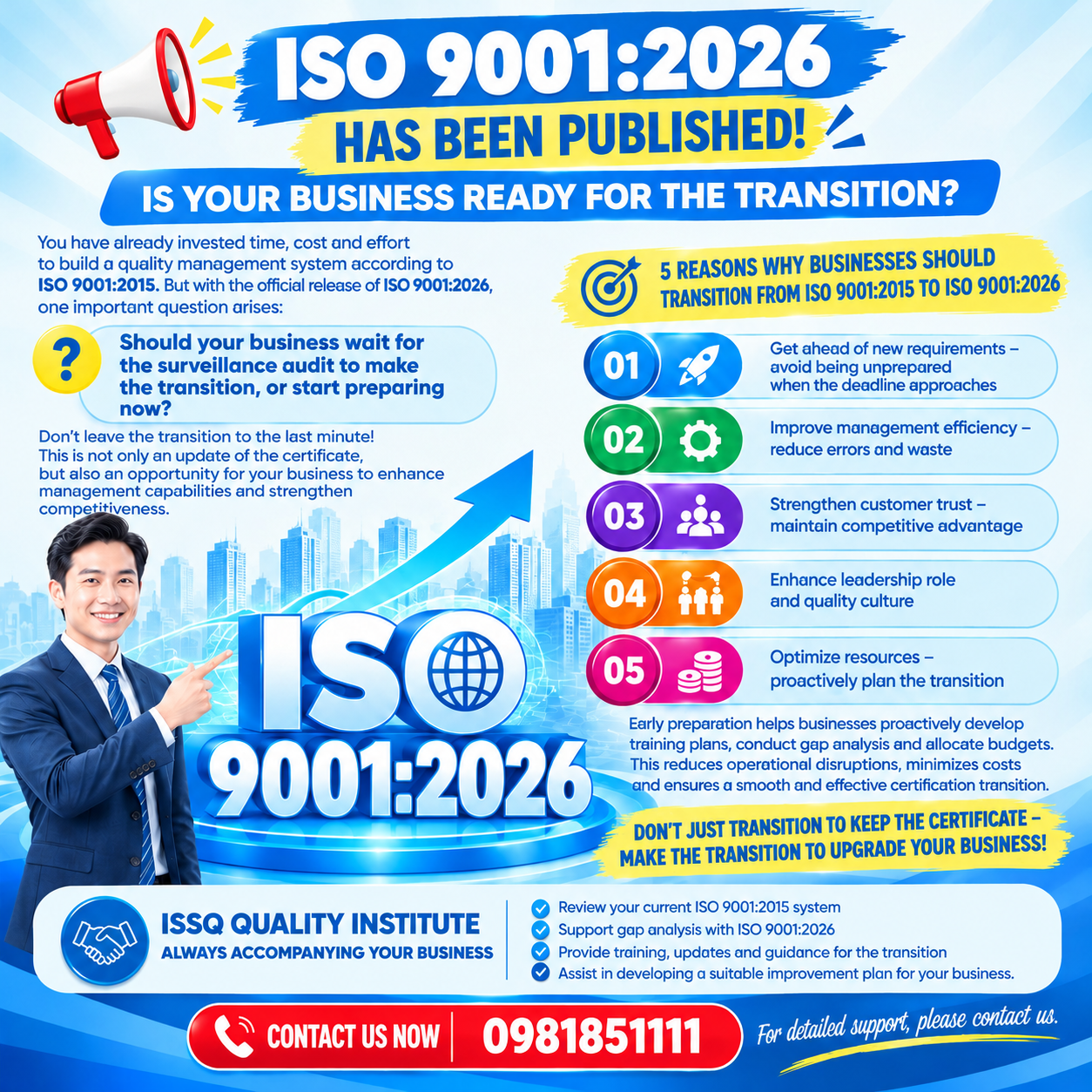
ISO 9001:2026 is the new version of the international standard for quality management systems, officially published on September 16, 2026, replacing the ISO 9001:2015 edition. This transition is not merely a requirement to update standards, but also presents an opportunity for enterprises to enhance management efficiency, control risks, improve product quality, and boost market competitiveness.
In a market where customers are increasingly demanding regarding quality, transparency, and fulfillment capacity, enterprises that proactively transition to ISO 9001:2026 early will have additional time to refine their systems, train personnel, and optimize operational processes. What are the key updates in ISO 9001:2026? Why should businesses start transitioning right now? What advantages can be achieved by applying the new version?
Today's market is witnessing increasingly fierce competition among domestic and international businesses. Customers care not only about pricing but also pay close attention to product quality, service consistency, delivery timelines, information traceability, and supplier professionalism.
For manufacturing enterprises, a minor error in quality control can trigger a series of consequences such as increased production costs, defective goods, delayed delivery schedules, and damage to brand reputation. For service providers, inconsistent quality across deliveries can erode customer trust and cause them to switch to competitors.
Therefore, establishing a quality management system according to ISO 9001 is no longer merely an activity to satisfy certification audit requirements. It serves as a tool helping businesses establish systematic management methods, define clear responsibilities, and maintain continuous improvement.
ISO 9001:2015 has been widely implemented across many organizations. However, alongside shifts in the business environment, companies must regularly review the suitability of their management system against strategy, customer needs, and emerging risks.
The ISO 9001:2026 edition inherits the proven foundation of quality management while clarifying several requirements concerning leadership roles, quality culture, risk and opportunity management, organizational knowledge, and continual improvement.
This offers an opportunity for enterprises to review operational methods, eliminate outdated procedures, and align their quality management systems more closely with actual business operations.
An effective quality management system must adapt to market changes, technology advancements, legal requirements, and customer expectations. If an enterprise merely maintains documentation based on the old version without regularly evaluating system effectiveness, procedures can gradually become superficial and cease to adequately support production and business activities.
Transitioning to ISO 9001:2026 is an occasion for enterprises to re-evaluate the entire system—from quality objective planning, resource management, and process control to internal audits and improvement. The earlier a business prepares, the better equipped it will be to execute a structured transition, avoiding rushed documentation updates as the transition deadline approaches.
ISO 9001:2026 is built upon the foundation of the 2015 version. Significant changes focus on clarifying the understanding and application of requirements, enhancing alignment with the common structure of management system standards, and reflecting modern business contexts.
Enterprises should cross-examine the official standard document against their current system to identify exact contents requiring updates.
Leadership commitment remains a critical factor determining the effectiveness of a quality management system. The 2026 edition continues to emphasize leadership roles, accountability, and the fostering of a quality culture within the organization.
Accordingly, quality management must be tied to enterprise growth targets and strategic orientation, rather than delegated solely to the quality management department or ISO personnel.
Top management must demonstrate leadership by allocating resources, defining responsibilities, monitoring target achievements, and encouraging inter-departmental collaboration to resolve quality issues.
When responsibilities are clearly defined, organizations can prevent task avoidance, enhance initiative, and improve cross-departmental coordination efficiency.
Quality is determined not only by machinery, equipment, or technical procedures, but also by workforce awareness and behavior.
A sustainable quality management system should help employees understand their role in product/service quality and customer satisfaction. Simultaneously, businesses need to encourage honesty, responsibility, and proactive reporting of issues that could impact quality.
Focusing on quality culture and ethical behavior helps organizations build a professional working environment, minimize error concealment, and heighten procedural compliance.
Risk management is a core element of ISO 9001. With the 2026 edition, requirements and guidance regarding risks and opportunities are further clarified to support organizations in understanding and applying them effectively.
In practice, risks can arise from various sources such as substandard raw materials, equipment downtime, incompetent personnel, delayed supplier deliveries, changing customer demands, or market fluctuations.
Enterprises must identify issues capable of affecting quality objectives, assess impact levels, and formulate appropriate control measures. Concurrently, identifying opportunities enables companies to seek product improvement options, optimize processes, and raise resource utilization efficiency.
Knowledge accumulated during operations represents a vital organizational asset. If experience resides solely within individuals or is not shared across departments, the organization may face difficulties during staff turnover or unexpected incidents.
Reviewing requirements related to organizational knowledge helps companies examine how necessary operational information is collected, retained, updated, and shared.
Furthermore, continual improvement must be driven by data, audit findings, customer feedback, and root cause analysis of issues. Organizations should target measurable improvements rather than symbolic activities.
Climate change was introduced into context analysis through the ISO 9001:2015/Amd 1:2024 amendment. This content is fully integrated into the context requirements of the ISO 9001:2026 edition.
Enterprises must determine whether climate change is an issue relevant to their quality management system. For instance, extreme weather events could impact supply chains, raw material sourcing, storage conditions, or delivery capabilities.
Not all businesses are affected equally. The essential step is for the organization to evaluate its actual context, identify relevant factors, and take appropriate action when necessary.
The ISO 9001:2026 edition features adjustments in phrasing, terminology consistency, and explanatory annexes to help users better understand the intent of requirements.
This serves as a basis for companies to review existing processes, documents, and implementation methods. However, businesses should not assume that all forms and procedures from the 2015 version must be replaced. Processes operating effectively can continue to be utilized if compliant with 2026 requirements.
Note: Enterprises must refer to the official ISO 9001:2026 standard text to perform gap analysis. The points above provide a general overview and do not replace clause-by-clause comparison.
ISO 9001:2026 was officially published on September 16, 2026. According to transition guidelines published by ISO, organizations currently certified under ISO 9001:2015 have a transition window open until September 30, 2029.
Preparation time needs to be allocated for studying the standard, conducting gap assessments, training personnel, adjusting systems, and coordinating with certification bodies.
Enterprises should contact their certification body to confirm transition timelines, assessment conditions, and applicable requirements for their specific circumstances.
If numerous companies compress their transition efforts into the final phase, demand for training, consulting, and auditing services may surge. This can create scheduling bottlenecks, auditor shortages, and difficulties in system update planning.
Transitioning early grants companies adequate time to select suitable options, prepare budgets, and arrange workloads without causing significant disruptions to core business operations.
A quality management system cannot operate effectively through document revisions alone. Following updates, enterprises must communicate new requirements, guide employee execution, gather operational evidence, and evaluate whether changes yield intended results.
Starting early enables companies to spot operational mismatches and make timely adjustments prior to the formal transition audit.
ISO 9001 certification often serves as a key benchmark for clients evaluating supplier management capabilities. A clear transition plan helps companies work proactively with certification bodies and avoids risks of certification lapses.
For businesses participating in supply chains, export markets, or bidding processes, special attention should be paid to client and partner requirements regarding standard versions, transition timing, and certification status.
Transitioning to ISO 9001:2026 provides an opportunity to re-examine objectives, responsibilities, and operational control methods. When processes are designed realistically, leadership can monitor operational performance more clearly and make data-driven decisions.
Reviewing risks, controlling processes, and analyzing root causes help companies proactively prevent defects rather than reactively handling consequences.
When issues are detected early, companies can lower non-conformance rates, minimize rework, reduce material waste, and save time on complaint handling.
An effective quality management system maintains consistency in products and services while strengthening the ability to meet committed deliverables.
Systematically gathering, analyzing, and resolving customer feedback also helps businesses identify areas needing improvement, consolidating reputation and fostering long-term partnerships.
ISO 9001 certification supports businesses in demonstrating quality management capabilities to clients, partners, and stakeholders. In various sectors, certification is a prerequisite required by buyers during supplier selection or supply chain onboarding.
Proactively transitioning to the 2026 version demonstrates commitment to improvement and raises adaptability to market shifts.
However, certification alone does not guarantee winning tenders, increasing revenue, or client selection. Commercial value depends on how effectively the enterprise operates the system and meets specific market demands.
The transition journey provides an occasion to re-train workforce awareness, clarify job-specific responsibilities, and upgrade internal auditor skills.
When employees clearly understand quality targets and the impact of their work, companies can improve workforce initiative, reduce dependency on key individuals, and cultivate a accountability-based work culture.
In a volatile business environment, organizations must possess the agility to adapt procedures when technology, personnel, suppliers, or customer requirements change.
Strengthening the quality management system under ISO 9001:2026 provides organizations with structured methods to assess impacts, assign responsibilities, execute changes, and review results—laying a solid foundation for long-term growth.
To execute an effective transition, enterprises can adopt the following 6-step framework:
Study the ISO 9001:2026 Standard: Leadership and ISO steering teams study the official standard text to identify requirements impacting the current system.
Conduct Gap Analysis: Compare the current management system against new version criteria, determining compliant areas, required adjustments, and priority items.
Formulate a Transition Plan: Establish timelines, assign responsibilities, budget resources, and set implementation milestones matching company operations.
Update System & Conduct Training: Revise procedures and necessary documentation; communicate updated requirements to leadership, process owners, staff, and internal auditors.
Implement, Monitor & Audit Internally: Operate the updated system, collect evidence of execution, evaluate compliance through internal audits, and correct non-conformities.
Undergo Transition Audit: Coordinate with the certification body to finalize audit schedules, document submissions, and certification conversion arrangements.
Enterprises should view this process as a strategic management system upgrade rather than a mere document-editing exercise for audit compliance.
For a smooth transition, enterprises require clear implementation methodologies, qualified personnel, and customized plans tailored to operational characteristics.
ISSQ Quality Institute provides ISO training and certification assessment services to support enterprises in raising awareness, perfecting management capabilities, and implementing quality management systems based on real-world needs.
Key support areas include:
ISO 9001:2026 awareness training for leadership and staff.
Internal auditor training to elevate system assessment capabilities.
Guidance on reviewing ISO 9001:2015 systems and performing gap analysis against the 2026 edition.
Assistance in drafting transition roadmaps, updating procedures, and improving quality control schemes.
Support in preparing for transition audit activities per certification body requirements.
Training or advisory program selection should be tailored to company scale, industry sector, current system maturity, and corporate growth targets.

ISO 9001:2026 not only marks a new edition of the quality management standard, but also creates a valuable opportunity for enterprises to review and upgrade corporate governance. Emphasizing leadership roles, quality culture, risk management, organizational knowledge, and continual improvement helps businesses build an efficient, realistic management system fitted for modern business environments.
Although certified organizations have until September 30, 2029 to transition, early preparation reduces operational pressure, optimizes resource deployment, and ensures smooth implementation.
Do not wait until the deadline approaches. Review your system, train your team, and build your ISO 9001:2026 transition roadmap starting today to turn standard updates into opportunities for quality enhancement, operational optimization, and sustainable growth.
ISSQ Quality Institute – Partnering with businesses in training, certification assessment, and quality management capability building.
For inquiries regarding training programs and customized ISO 9001:2026 transition plans, please contact ISSQ Quality Institute via hotline +84 981851111 or email vienchatluong@issq.org.vn | tcvn@issq.org.vn for procedural guidance.


