
INSTITUTE FOR STANDARD AND QUALITY DEVELOPMENT STUDIES


03/04/2026
In an increasingly volatile economic market, organizations face numerous risks that can disrupt operations, such as supply chain interruptions, technological failures, or changing market demands. This creates a need for maintaining stable operations and adapting promptly.
Let’s explore with ISSQ Quality Institute the role of ISO 22301 in supporting organizations to maintain business continuity in the current context.
ISO 22301 is an international standard for the Business Continuity Management System (BCMS). It specifies requirements for establishing, implementing, maintaining, and continually improving a BCMS, helping organizations maintain operational capability during disruptions.
According to the standard, ISO 22301 aims to help organizations:
ISO 22301 is structured as a management system, including elements such as:
This standard can be applied to any organization, regardless of size, sector, or type of activity, with the level of application depending on the organization’s context and complexity.
ISO 22301 is not merely a set of requirements but a management framework that enables organizations to proactively control disruption risks and ensure business continuity under adverse conditions.
In a volatile economic environment, organizations face numerous risks that directly affect their ability to maintain operations. Implementing ISO 22301 helps establish a management system to identify, control, and minimize these impacts.
Factors such as geopolitical conflicts, logistics disruptions, and raw material price fluctuations significantly impact supply chains. Organizations relying on external supply sources may face difficulties maintaining operations when disruptions occur.
Digital transformation increases dependence on IT systems. Incidents such as cyberattacks, data loss, or system downtime can halt operations without proper control and recovery measures.
Changes in market demand, inflation, or economic policies can directly impact business operations. The ability to adapt quickly and maintain stable operations becomes essential.
Organizations also face internal risks such as operational disruptions, workforce shortages, or process errors. If not effectively managed, these can significantly affect overall performance.
Although these risks differ in origin, they share a common characteristic: the potential to disrupt business operations if not systematically controlled. This is why ISO 22301 has become an essential tool for maintaining business continuity.

In today’s volatile economic environment, disruptions are no longer rare but have become a constant factor. ISO 22301 enables organizations to proactively control and minimize impacts through a structured management system.
ISO 22301 requires organizations to identify priority activities, define required capabilities, and develop response and recovery plans, enabling continued delivery of products and services within acceptable timeframes.
The standard requires Business Impact Analysis (BIA) and risk assessment, helping identify vulnerabilities and implement appropriate controls, thereby reducing costs and financial/legal impacts.
The BCMS helps build resilience and recovery capability through strategies, solutions, and continuity plans, which are critical in rapidly changing environments.
Maintaining stable operations during disruptions helps protect organizational reputation and builds trust among customers, partners, and stakeholders.
ISO 22301 integrates business continuity with strategic goals through policies, objectives, and continuous improvement based on the PDCA cycle.
In the current context, ISO 22301 serves as a management foundation that helps organizations not only respond to disruptions but also maintain stability and long-term adaptability.
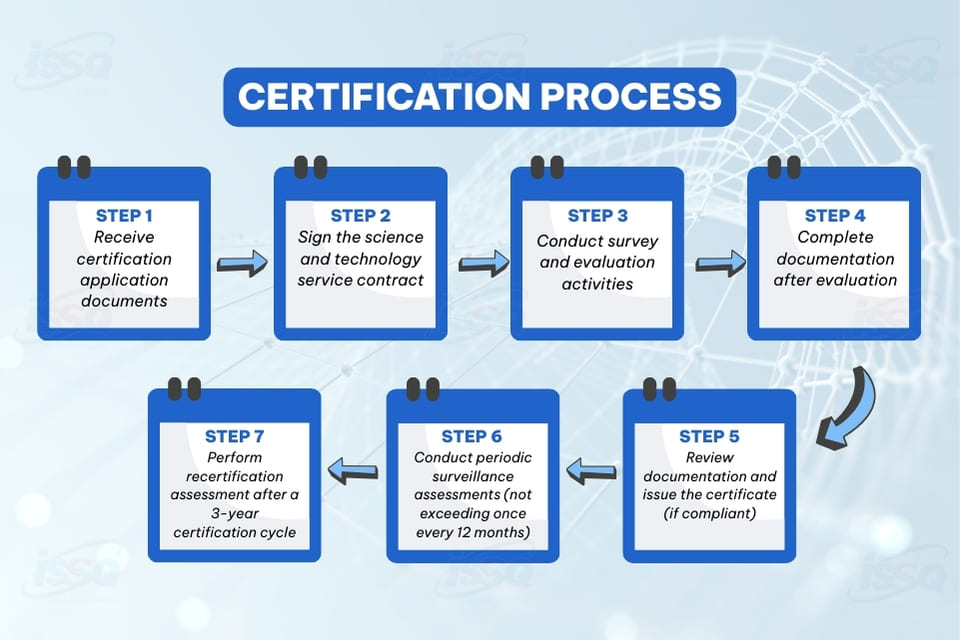
To obtain ISO 22301 certification, organizations must undergo a systematic assessment process to evaluate conformity with the standard requirements. The process ensures objectivity, transparency, and consistency.
The certification process at ISSQ Quality Institute includes:
In today’s volatile economic environment, ensuring business continuity is no longer optional but essential for organizational stability and development. ISO 22301 provides a management framework to proactively identify risks, develop response plans, and maintain operations during disruptions.
Implementing and obtaining ISO 22301 certification helps organizations enhance adaptability, strengthen reputation, and build stakeholder trust. It is a critical foundation for stable operations and sustainable long-term development.
For ISO 22301 certification services, please contact ISSQ Quality Institute via Hotline: +84981851111 or email: vienchatluong@issq.org.vn | tcvn@issq.org.vn for support.
Published date: April 3, 2026


