
INSTITUTE FOR STANDARD AND QUALITY DEVELOPMENT STUDIES


Certification of conformity for student desks and chairs in accordance with TCVN 7490:2005 not only demonstrates that products comply with the Vietnamese National Standard but also delivers numerous practical benefits to manufacturers, educational institutions, students, and parents.
Student desks and chairs are essential educational equipment that directly affects students' sitting posture, health, and physical development throughout their school years. Selecting and using furniture that matches students' anthropometric characteristics not only helps create a comfortable learning environment but also contributes to preventing common school health problems.
Certification of conformity for student desks and chairs according to TCVN 7490:2005 is an assessment activity that verifies and demonstrates a product's compliance with the technical requirements specified in the Vietnamese National Standard. Through this process, product quality is enhanced while strengthening the confidence of customers and educational institutions.
Join the ISSQ Institute of Quality in exploring the requirements of TCVN 7490:2005 and the benefits of certification of conformity for student desks and chairs in the article below.
Student desks and chairs are among the key factors in creating a safe, comfortable learning environment that supports students' physical development. When these products fail to satisfy dimensional requirements based on users' anthropometric characteristics, various negative impacts may arise for students, educational institutions, and manufacturers alike.
Using desks and chairs that are inappropriate for students' body dimensions and age groups may cause them to maintain incorrect sitting postures for prolonged periods, increasing the risk of scoliosis, kyphosis, uneven shoulders, and pain in the neck, shoulders, upper back, or lower back.
Furniture with inappropriate dimensions may alter students' viewing distance, increasing the likelihood of refractive errors, causing eye fatigue, and reducing their ability to concentrate during learning.
When consumers select desks and chairs that have not undergone conformity assessment, educational institutions may encounter difficulties during procurement, acceptance, and compliance with facility requirements prescribed by applicable regulations.
Manufacturers whose products have not been certified against the applicable standard lack objective evidence to demonstrate product quality, thereby reducing their competitive advantage when supplying furniture to schools and educational projects.
The issues above demonstrate that certification of conformity for student desks and chairs in accordance with TCVN 7490:2005 not only contributes to protecting students' health but also supports educational institutions and manufacturers in improving management efficiency, product selection, and the supply of products that meet practical requirements.
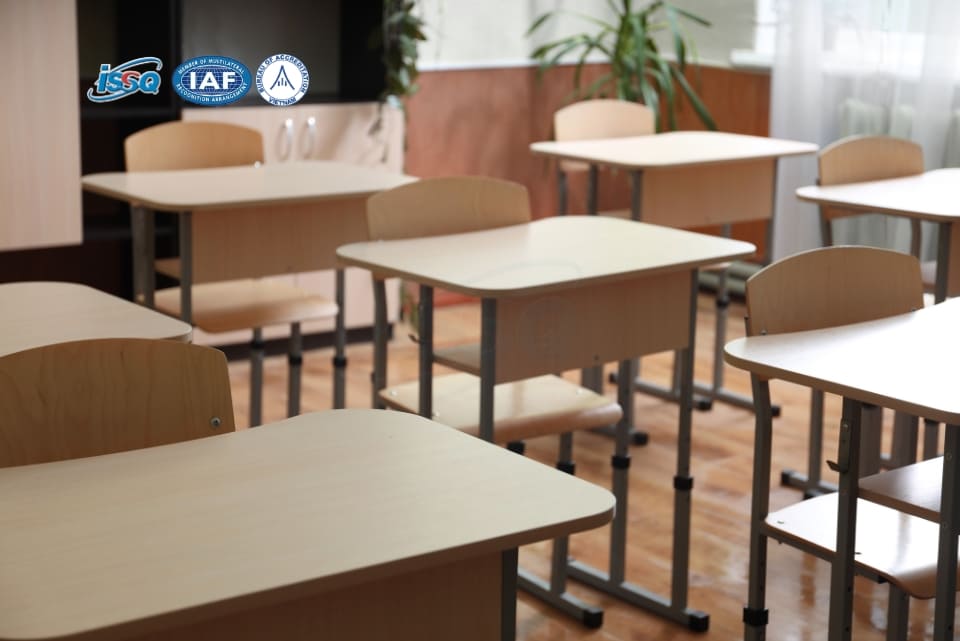
TCVN 7490:2005 is the Vietnamese National Standard titled Primary and Lower Secondary School Desks and Chairs – Requirements for Basic Dimensions Based on Students' Anthropometric Indices.
This standard specifies the basic dimensional requirements for desks and chairs used by students from Grade 1 to Grade 9, ensuring that the products are compatible with students' physical development characteristics at each stage of their education.
To determine appropriate furniture dimensions, TCVN 7490:2005 uses students' anthropometric measurements as the basis for assessment.
| Anthropometric Index | Description |
|---|---|
| Standing height (body height) | The vertical distance from the floor to the top of the head. |
| Sitting height (upright posture) | The vertical distance from the seat surface to the top of the head. |
| Sitting eye height | The vertical distance from the seat surface to the outer corner of the eye. |
| Sitting shoulder height | The vertical distance from the seat surface to the acromion (shoulder tip). |
| Bi-deltoid breadth | The horizontal distance between the outermost points of the left and right deltoid muscles. |
| Hip breadth (sitting position) | The maximum horizontal distance across the hips while seated. |
| Sitting elbow height | The vertical distance from the seat surface to the lowest point of the elbow when the forearm is bent at a right angle to the upper arm. |
| Lower leg length (popliteal height) | The vertical distance from the floor to the underside of the thigh at the back of the knee (popliteal region). |
| Buttock-to-popliteal length | The horizontal distance from the back of the knee (popliteal fossa) to the rearmost point of the buttocks. |
| Chest depth at nipple level | The maximum depth of the chest measured at nipple level. |
| Upper arm length | The straight-line distance from the acromion (shoulder tip) to the lowest point of the elbow when the forearm is bent at a right angle to the upper arm. |
| Thigh thickness | The vertical distance from the seat surface to the highest point of the thigh. |
| Forward reach | The horizontal distance from the vertical reference plane to the axis of the clenched hand when the subject stands with both shoulder blades against the vertical plane. |
Establishing desk and chair dimensions based on anthropometric measurements helps ensure compatibility between the product and students' physical characteristics. This supports proper sitting posture, contributes to reducing the risk of school-related health problems, and enhances students' comfort throughout the learning process.
Certification of conformity for student desks and chairs in accordance with TCVN 7490:2005 not only demonstrates that products comply with the Vietnamese National Standard but also provides significant practical benefits for manufacturers, educational institutions, students, and parents.
Certification of conformity for student desks and chairs in accordance with TCVN 7490:2005 not only delivers economic and commercial benefits to manufacturers but also helps ensure appropriate learning conditions, supports school health care, and contributes to the sustainable improvement of educational quality.

To obtain a Certificate of Conformity for student desks and chairs in accordance with TCVN 7490:2005, organizations and enterprises may follow the basic certification process below:
Step 1: Receive and review the certification application dossier.
Step 2: Sign the science and technology service contract.
Step 3: Conduct surveys and conformity assessment activities.
Step 4: Complete the post-assessment documentation.
Step 5: Review the assessment dossier and issue the Certificate of Conformity (if all requirements are satisfied).
Step 6: Conduct surveillance assessments at intervals of no more than 12 months.
Step 7: Carry out recertification after the certificate expires.
Selecting and using student desks and chairs that match students' anthropometric characteristics is one of the key factors in protecting students' health and improving the quality of the educational environment. Certification of conformity for student desks and chairs in accordance with TCVN 7490:2005 not only enables manufacturers to demonstrate product quality, enhance their reputation, and strengthen their competitiveness, but also assists educational institutions in selecting furniture that meets students' practical needs.
Through conformity assessment and certification, all relevant stakeholders gain a reliable basis for ensuring that products comply with the technical requirements of the Vietnamese National Standard, thereby contributing to the development of a safe, comfortable learning environment that supports students' comprehensive physical development.
If your organization requires certification of conformity for student desks and chairs in accordance with TCVN 7490:2005, please contact the ISSQ Institute of Quality for assistance with the certification process:
Publication Date: June 29, 2026


