
INSTITUTE FOR STANDARD AND QUALITY DEVELOPMENT STUDIES


The ISO 45001 Occupational Health and Safety Management System provides the criteria and framework to improve labor safety, minimize workplace risks, and create safer working conditions. This standard is applicable to all businesses regardless of geographical location, size, type, or the products and services provided.
According to the International Labour Organization (ILO), there are approximately 2.78 million deaths and 374 million non-fatal work-related injuries and illnesses globally each year.
The ILO estimates that the total cost of these injuries and illnesses amounts to roughly 3.94% of global GDP, or approximately $2.99 trillion USD.
To help companies address this issue, ISO developed a new regulation based on OH&S standards: ISO 45001:2018 – Occupational Health and Safety Management Systems.
Global Recognition: It is the premier international standard for OH&S management.
Purpose: It helps organizations prevent injuries and ill health while providing a safe and healthy workplace.
Structure: It follows a 10-clause structure designed to align with other ISO management standards.
The 10 Clauses of ISO 45001:
Clauses 1–3: Scope, Normative References, and Terms & Definitions.
Clause 4: Context of the Organization
Clause 5: Leadership and Worker Participation
Clause 6: Planning for the OH&S System
Clause 7: Support
Clause 8: Operation
Clause 9: Performance Evaluation
Clause 10: Improvement
Legal Compliance: Provides a framework to identify, monitor, and comply with all legal, regulatory, and contractual requirements, helping avoid heavy fines.
Enhanced Reputation: Many clients—especially in construction—require ISO 45001 certification before awarding contracts or tenders.
Reduced Personnel Costs: Safer environments lead to higher employee retention, reducing recruitment and retraining costs. It also prevents work interruptions caused by accidents.
Process Improvement: Continuous improvement is a core requirement, leading to more efficient operational processes.
Worker Well-being: The primary goal is to reduce risks that lead to physical or mental harm.
Implementing this standard can be complex. Here is a simplified 12-step roadmap:
Management Commitment: Secure approval and strategic support from leadership.
Identify Legal Regulations: Research and list all OH&S laws relevant to your industry.
Define Scope: Determine if the system applies to the whole company or specific locations.
Develop Processes & Procedures: Define how hazards are identified and risks are assessed. (Note: Many firms hire consultants like ISSQ for this step).
Implement Procedures: Put the drafted processes into daily practice across the company.
Staff Training: Ensure employees understand the "why" and "how" of the new system.
Operate & Record: Maintain records to prove the system is functioning.
Internal Audit: Use internal checks to find gaps in the system.
Management Review: Leaders evaluate the system’s overall effectiveness.
Corrective Actions: Address the root causes of any non-conformities found during audits.
Select a Certification Body: Choose a reputable partner based on their expertise, timeline, and cost.
Certification Audit: An external body verifies your system against ISO requirements.
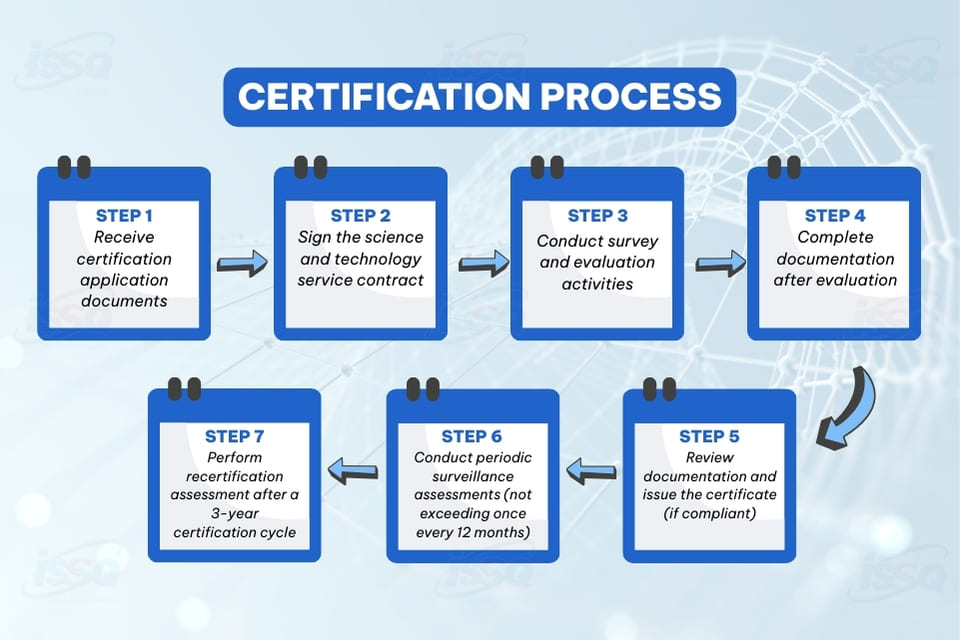
The Institute for Quality Standard Development Research (ISSQ) follows a professional 4-step process:
Step 1: Registration & Agreement: Formalize the certification contract.
Step 2: Information Review & Planning: ISSQ creates a detailed audit plan (dates, locations, experts).
Step 3: Document Review & On-site Audit: Experts verify documentation and physical safety conditions at the workplace.
Step 4: File Review & Issuance: After a successful audit, the ISO 45001 certificate is issued.
Note: The certificate is valid for 3 years, with mandatory surveillance audits at least every 12 months.
Contact Us: The ISSQ Institute is ready to accompany your company in the era of integration.
Hotline: 0981851111 | 02422661111
Email: vienchatluong@issq.org.vn | tcvn@issq.org.vn
Date Published: April 10, 2021


