
INSTITUTE FOR STANDARD AND QUALITY DEVELOPMENT STUDIES


QCVN 12-3:2011/BYT specifies technical and management requirements on hygiene and safety for metal packaging and utensils that come into direct contact with food (hereinafter referred to as metal packaging and utensils). This regulation applies to organizations and individuals involved in the import, manufacture, trading, and use of metal packaging and utensils, as well as state management agencies and other related organizations and individuals.
Metal packaging and utensils are widely used in the food industry due to their high durability, good heat resistance, and convenience during storage and transportation. However, if the materials are not safe, metal substances or chemicals may migrate into food and affect consumer health.
Therefore, the Ministry of Health issued QCVN 12-3:2011/BYT to regulate hygiene and safety requirements for metal packaging and utensils that come into direct contact with food. Let ISSQ Quality Institute explore this regulation, its technical requirements, and the conformity certification process in the article below.
Metal packaging and utensils are products manufactured from metal materials or metal alloys and used for containing, preserving, processing, or directly contacting food during production and use.
Commonly used metal materials include: stainless steel, aluminum, tin, coated steel, and other metal alloys.
Today, metal packaging and utensils are commonly used in many food and daily-life applications such as canned food containers, metal food containers, stainless steel trays, pots, pans, spoons, forks, knives, metal water bottles, and metal food containers.
Thanks to their durability, heat resistance, and reusability, metal products are widely chosen by businesses and consumers. However, if the raw materials or surface coatings do not meet quality requirements, substances such as lead, cadmium, or other chemical compounds may migrate into food during use.
Therefore, metal packaging and utensils that directly contact food must comply with safety requirements under QCVN 12-3:2011/BYT before being circulated on the market.

Metal packaging and utensils that directly contact food are often used under conditions involving high temperatures, high humidity, or acidic and oily environments. If manufacturing materials do not meet quality requirements, heavy metals or residual chemicals may migrate into food during use.
Common risks include:
These factors not only affect food quality but may also pose risks to consumer health through long-term exposure.
In addition, under current regulations, metal packaging and utensils that directly contact food are subject to conformity declaration in compliance with QCVN 12-3:2011/BYT before being placed on the market. Conformity certification helps businesses control product quality, comply with state management requirements, and build trust with customers and partners.
QCVN 12-3:2011/BYT is the National Technical Regulation on hygiene and safety for metal packaging and utensils that directly contact food, issued by the Ministry of Health together with Circular No. 34/2011/TT-BYT dated August 30, 2011.
This regulation specifies technical and management requirements on hygiene and safety for metal packaging and utensils that directly contact food (hereinafter referred to as metal packaging and utensils).
QCVN 12-3:2011/BYT applies to organizations and individuals importing, manufacturing, trading, and using metal packaging and utensil products; state management agencies; and other related organizations and individuals.

| Migration Test | |||
| Test Item | Extraction Condition | Extraction Solution | Maximum Limit |
| Arsenic | 60°C for 30 minutes [5] | Water [3] | 0.2 μg/ml |
| 60°C for 30 minutes | 0.5% Citric Acid Solution [4] | ||
| Cadmium | 60°C for 30 minutes [5] | Water [3] | 0.1 μg/ml |
| 60°C for 30 minutes | 0.5% Citric Acid Solution [4] | ||
| Lead | 60°C for 30 minutes [5] | Water [3] | 0.4 μg/ml |
| 60°C for 30 minutes | 0.5% Citric Acid Solution [4] | ||
| Phenol | 60°C for 30 minutes [5] | Water | 5 μg/ml [8] |
| Formaldehyde | Negative [8] | ||
| Dry Residue | 25°C for 1 hour | Heptane [1], [6] | 30 μg/ml [8] |
| 60°C for 30 minutes | 20% Ethanol [2] | ||
| 60°C for 30 minutes [5] | Water [3], [7] | ||
| 4% Acetic Acid [4] | |||
| Epichlorohydrin | 25°C for 2 hours | Pentane | 0.5 μg/ml [8], [9] |
| Vinyl Chloride | Not exceeding 5°C for 24 hours | 20% Ethanol | 0.05 μg/ml [8] |
[1] Samples used for containing fats, edible oils, and fatty foods.
[2] Samples used for containing alcoholic beverages.
[3] Samples used for containing foods with pH greater than 5.
[4] Samples used for containing foods with pH less than or equal to 5.
[5] For utensils used at temperatures above 100°C, the extraction condition shall be 95°C for 30 minutes.
[6] Dry residue content shall not exceed 90 μg/ml where the sample is a canned product internally coated with a layer mainly composed of natural oils or fats and where the zinc oxide content in the coating exceeds 3%.
[7] The quantity of chloroform-soluble substances (limited to 30 μg/ml or less) shall be determined when a sample can be used similarly to [6] and the quantity exceeds 30 μg/ml.
[8] Not applicable to uncoated metal packaging and utensils that do not have a synthetic resin layer directly contacting food.
[9] The eluate solution has been concentrated 5 times, although the concentration in the eluate does not exceed 25 μg/ml.
Conformity certification according to QCVN 12-3:2011/BYT not only helps businesses comply with state management requirements but also provides many benefits in production, business operations, and brand reputation building.
It can be seen that implementing conformity certification according to QCVN 12-3:2011/BYT not only helps businesses comply with quality management and food safety requirements but also enhances brand reputation, increases competitiveness, and builds customer trust in the market.
This also serves as a basis for businesses to proactively control product quality and move toward sustainable development in the production and trading of food-contact packaging and utensils.

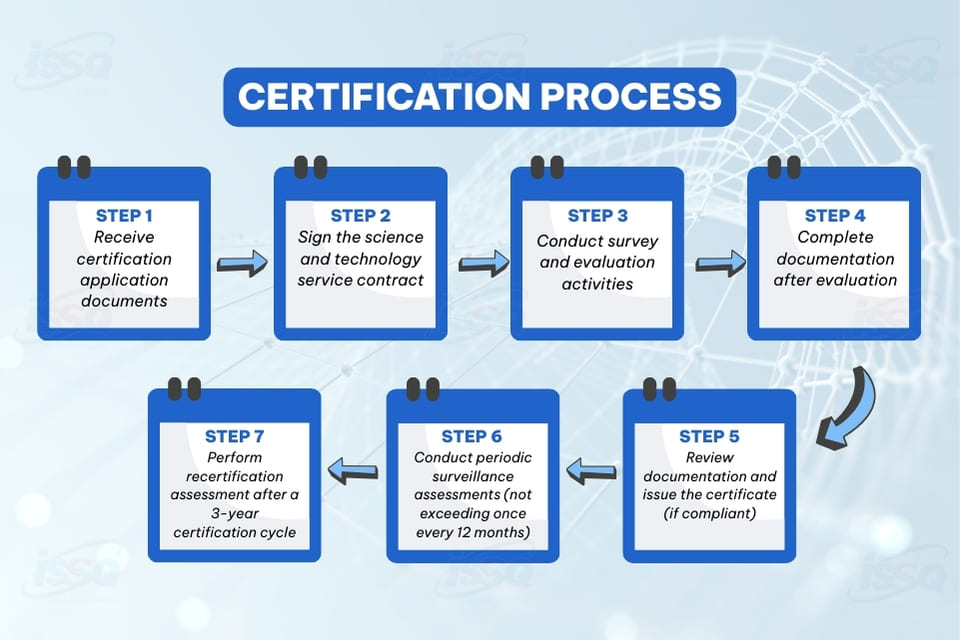
To certify metal packaging and utensils in compliance with QCVN 12-3:2011/BYT, the process generally includes the following steps:
Step 1: Receive certification registration documents
Step 2: Sign scientific and technological service contract
Step 3: Conduct survey and assessment
Step 4: Complete post-assessment documentation
Step 5: Review documents and issue certificate (if compliant)
Step 6: Conduct surveillance assessment at intervals not exceeding 12 months
Step 7: Conduct recertification assessment (certificate validity expires after 3 years)
Metal packaging and utensils that directly contact food are products that directly affect food quality and safety during use. Therefore, compliance with QCVN 12-3:2011/BYT not only helps businesses comply with current regulations but also contributes to improving product quality and building trust with customers and partners.
Through conformity certification activities, businesses can proactively control risks of chemical migration, complete legal documentation, and enhance market reputation.
If your company needs QCVN 12-3:2011/BYT conformity certification for hygiene and safety of metal packaging and utensils that directly contact food, please contact ISSQ Quality Institute via hotline: +84 981851111 or email: vienchatluong@issq.org.vn | tcvn@issq.org.vn for support.
Published date: 06/05/2026


