
INSTITUTE FOR STANDARD AND QUALITY DEVELOPMENT STUDIES


The ISO 45001 standard is a system for managing occupational health and safety, providing criteria and a framework to improve workplace safety, reduce risks, and create safer working conditions.
The ISO 45001 standard is applicable to all enterprises regardless of geographical location, size, type, or the products and services they provide.
Occupational safety and health are always leading criteria for employees when selecting a workplace and dedicating their efforts. Therefore, prioritizing the implementation of Occupational Health and Safety Management Systems according to ISO 45001:2018 is extremely important for organizations and enterprises. This reflects care and responsibility toward employees while improving organizational credibility.
ISO 45001 was developed by the International Organization for Standardization (ISO) and published in March 2018 based on conventions and guidelines of the International Labour Organization (ILO) and national standards. ISO 45001 replaces the OHSAS 18001 standard and includes requirements and guidance for organizations to build and establish an effective occupational health and safety management system.
ISO 45001 has a common structure and approach similar to other management systems such as ISO 9001 and ISO 14001, including:
Part 1: Scope
Part 2: Normative references
Part 3: Terms and definitions
Part 4: Context of the organization
Part 5: Leadership and commitment
Part 6: Planning
Part 7: Support
Part 8: Operation
Part 9: Performance evaluation
Part 10: Improvement
ISO 45001 is an international management system; therefore, its implementation provides enterprises with more opportunities to integrate and cooperate with partners worldwide, gaining more opportunities in collaborative projects with customers.
The international standard ISO 45001:2018 is applicable to all types of organizations regardless of scope, size, or sector of operation: large and small organizations, private enterprises, non-profit organizations, government agencies, etc. The prerequisite is the organization’s desire to demonstrate commitment to creating a safe and professional working environment.
ISSQ Quality Institute is a designated certification body with competence in certifying management systems such as ISO 45001, ISO 9001, ISO 27001, ISO 20000, as well as product conformity certification.
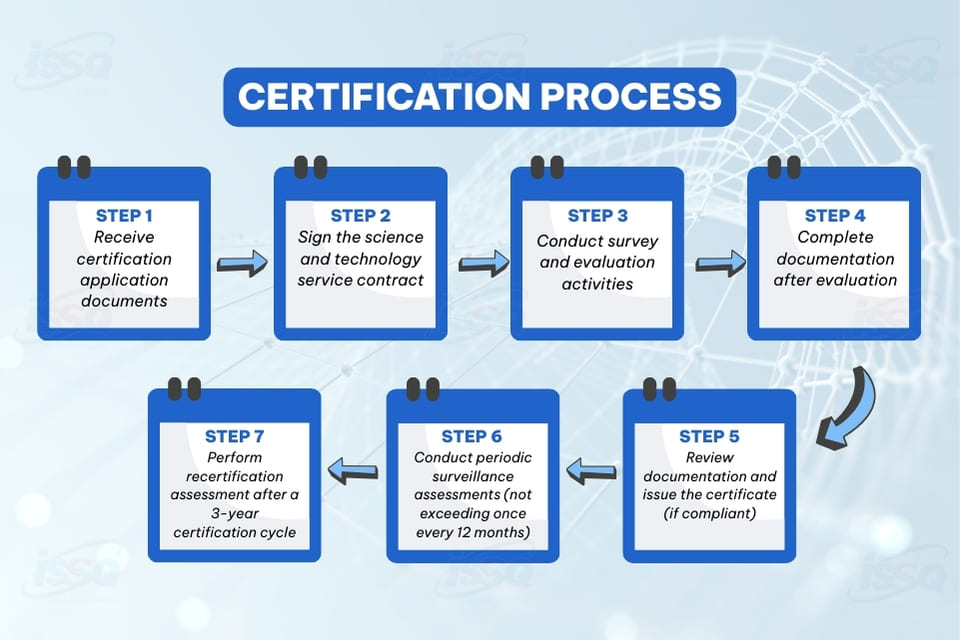
The certification process for ISO 45001:2018 in particular and other standards in general includes the following basic steps:
Step 1: Receiving certification application documents\
Step 2: Signing a science and technology service contract
Step 3: Conducting on-site surveys and assessments at the enterprise
Step 4: Completing documentation after assessment
Step 5: Reviewing documentation and issuing the certificate (if compliant)
Step 6: Conducting surveillance audits every 12 months
Step 7: Conducting recertification audits (certificate validity: 3 years)
It should be noted that implementing ISO 45001 is a long-term process requiring commitment and coordination across the entire organization. In return, the results bring improvements in employee safety and health and generate long-term benefits for the organization.
However, to achieve the most synchronized and comprehensive effectiveness, enterprises should consider integrating other quality management systems such as ISO 9001:2015 and Environmental Management System ISO 14001:2015 with ISO 45001.
We hope this article has provided useful and necessary information for readers.
ISSQ Quality Institute is always ready to accompany companies in the period of integration and development.
Please contact hotline: +84 981851111 or email vienchatluong@issq.org.vn | tcvn@issq.org.vn. We are honored to serve our valued customers.
Posted date: 20/09/2023


