
INSTITUTE FOR STANDARD AND QUALITY DEVELOPMENT STUDIES


ISO 20000-1 – IT Service Management System specifies requirements for organizations to establish, implement, maintain, and continually improve a service management system (SMS). The requirements include planning, design, transition, delivery, and improvement of services to meet service requirements and deliver value.
ISO/IEC 20000-1:2018 is the first international standard for IT Service Management (ITSM). It was first published in 2005, updated in 2011, and the current version is 2018.
This standard provides a comprehensive framework for IT service management, including processes, methods, and tools to support organizations in achieving their IT service-related objectives.
The international standard focuses on standardized management requirements such as service level management, incident management, change management, and other related processes.

Applying IT service management standards brings numerous benefits to businesses:
However, applying the standard—especially in a complex and constantly evolving technology environment—may present challenges and requires expert consultation and support.
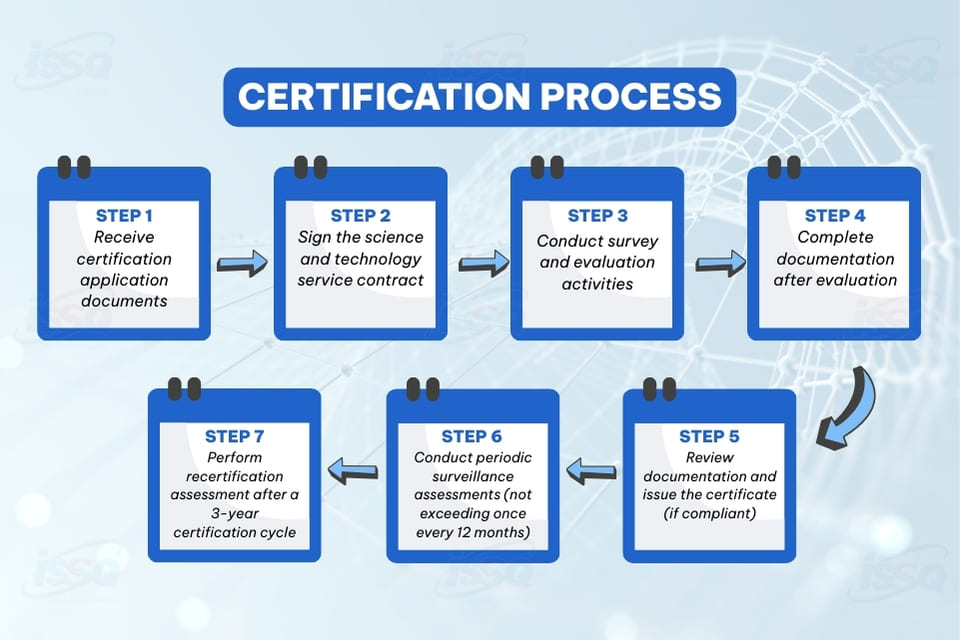
The Institute for Standards and Quality Development (ISSQ) is a certification body designated to assess and issue ISO/IEC 20000:2018 certificates. The evaluation and implementation guidance process is as follows:
Step 1: Receive certification application dossier
Step 2: Sign scientific and technological service contract
Step 3: Conduct survey and assessment
Step 4: Complete documentation after assessment
Step 5: Review documentation and issue certificate (if compliant)
Step 6: Conduct surveillance audits every 12 months
Step 7: Conduct recertification (certificate valid for 3 years)
The IT Service Management System can be applied to all organizations regardless of size or number of locations.
The evaluation time depends on multiple factors such as organizational size, departmental structure, number, and complexity of service management processes. Therefore, organizations should establish a clear implementation roadmap not only to meet standard requirements but also to continuously improve the quantity and quality of IT services provided.
Certification costs depend on the size, type of activities, and operational scope of the organization.
Applying IT Service Management standards requires investment in time and cost; however, the benefits help organizations manage risks and ensure the quality of IT services. ISSQ Quality Institute has been trusted by many organizations to provide implementation guidance, assessment, and ISO/IEC 20000-1:2018 certification.
ISSQ Quality Institute is always ready to accompany businesses in the process of integration and development.
Published date: July 24, 2023


